Just how much potential does the topic of “synthetic fuels” really hold for the future?
It’s quite simple: Synthetic fuels are and will continue to be a crucial building block for the future of mobility—even if our German and European “ElectricOnly” advocates still don’t want to hear it. The global ramp-up of synthetic fuels has long been in full swing and will continue to expand as we move toward the future.
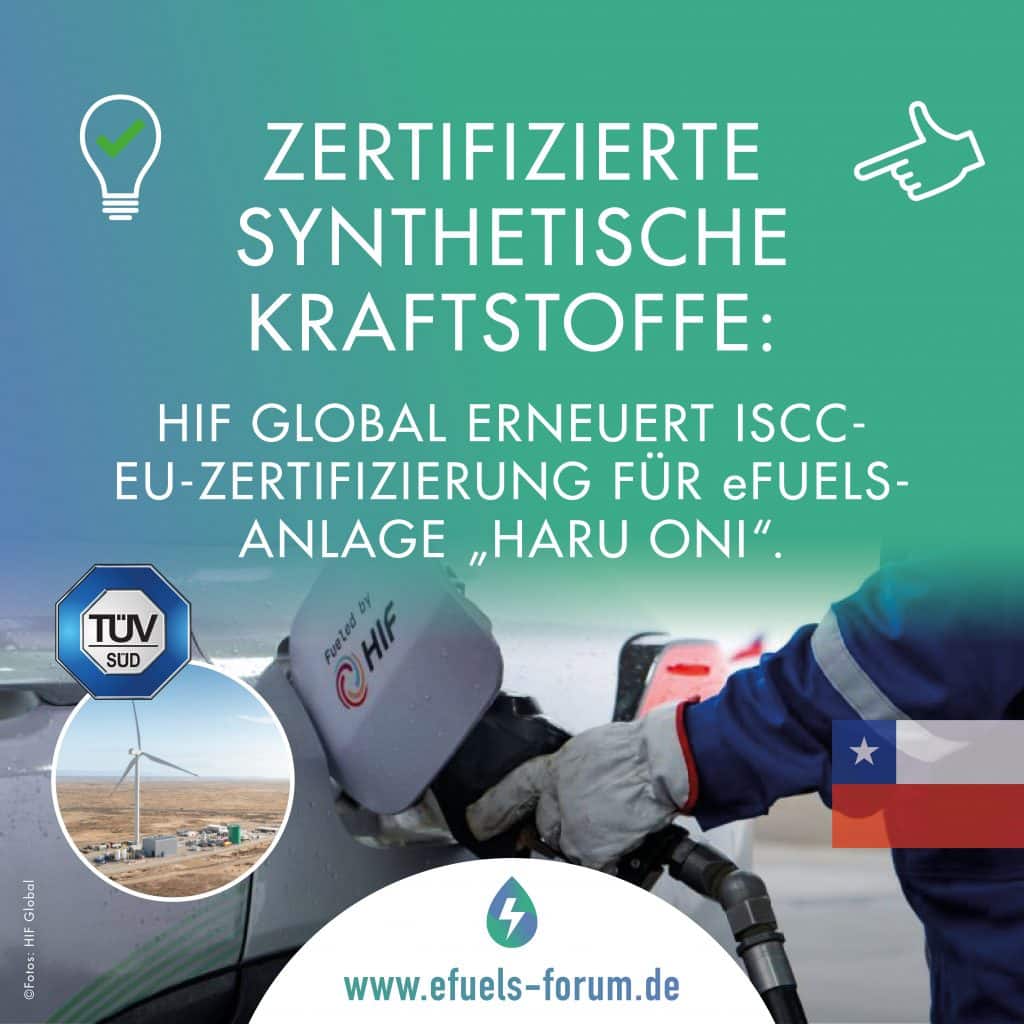
For example, HIF Global has just renewed its ISCC-EU certification for RFNBO production, thereby strengthening its ability to supply certified synthetic fuels.
Good to know:
The certification confirms that the facility continues to meet the European Union’s sustainability requirements for RFNBO, including requirements regarding the use of electricity from renewable energy sources, the reduction of greenhouse gas emissions, traceability, and the supply chain.
Important for anyone who has doubts:
The ISCC certification issued by TÜV SÜD is an independent certification system based in Germany and recognized by the European Commission. The certification covers Haru Oni’s entire value chain, including the procurement of carbon dioxide, hydrogen production, and the manufacture of eMethanol, eGasoline, and eLiquefied Gas (eLG), and confirms the plant’s ability to produce RFNBO-compliant fuels in accordance with the applicable certification requirements.
Information about the facility:
HIF Haru Oni, based in Punta Arenas, Chile, is, according to the company, the world’s first integrated eFuels facility to produce synthetic fuels using renewable electricity, recycled carbon dioxide, and green hydrogen. The facility has been producing eMethanol, eGasoline, and eLG since 2022.
Photo: HIF Global