
What does mobility cost? Between environmental considerations and public finances
What does mobility cost? Between environmental considerations and public finances
Transforming the transport sector is regarded as an important element in achieving legally defined climate and emission reduction targets. At the same time, transport generates substantial revenue for the state, including energy tax, motor vehicle tax and other charges. How does increasing electrification of transport affect this revenue? Which sources of government income could decline, and what options are available to offset this in future?
As of 23 September 2026. The following information relates to Germany. Funding conditions and tax law may change.
Traffic turnaround and state coffers: How the state earns from road traffic?
Transport contributes to government revenue through energy tax and motor vehicle tax, among other sources. These taxes are generally not earmarked for specific transport projects. National emissions trading is different: its proceeds go to the Climate and Transformation Fund.
Energy and electricity tax statistics also cover uses outside transport. Their totals must therefore not be attributed entirely to road transport.
Energy and vehicle tax as key sources of revenue
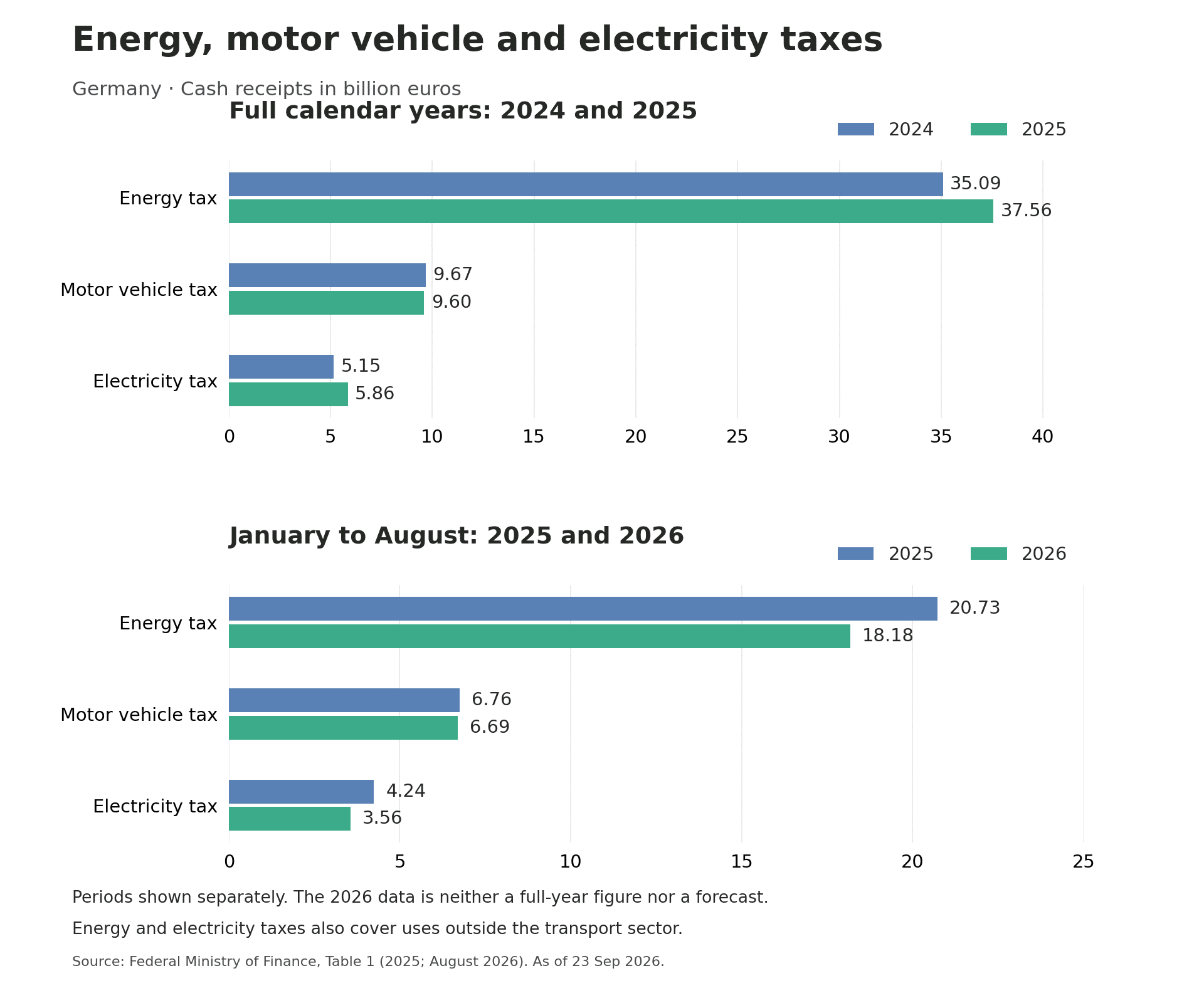
Energy tax
Mobility is currently the largest source of income.
Energy tax, billion euros:
- 2024: 35.09
- 2025: 37.56
- January–August 2025: 20.73
- January–August 2026: 18.18
The figures also include energy use outside transport.
Vehicle tax
This is also an important financial pillar for the national budget.
Motor vehicle tax, billion euros:
- 2024: 9.67
- 2025: 9.60
- January–August 2025: 6.76
- January–August 2026: 6.69
Electricity tax
Electricity tax, billion euros:
- 2024: 5.15
- 2025: 5.86
- January–August 2025: 4.24
- January–August 2026: 3.56
Source: Federal Ministry of Finance (BMF), cash tax receipts, overview 1 (calendar year 2025 and August 2026). Figures rounded. The original tables are available at this link.
Periods can only be compared within their respective groups. Changes in cash receipts can result from consumption, tax rates, relief measures and payment timing, among other factors; on their own, they do not demonstrate an effect of a particular propulsion technology.
As general budget revenue, energy tax and motor vehicle tax finance various government responsibilities. Falling sales of taxable fuels can reduce energy tax revenue. The extent of the budgetary impact also depends on other taxes, legislative changes and spending decisions.
More electric mobility changes the tax base: fuel consumption may disappear while additional electricity demand arises. Whether this creates a funding gap cannot be determined by directly comparing total energy tax and electricity tax revenue. A robust forecast requires assumptions about the vehicle fleet, mileage, energy consumption and tax rates.
Government revenue at the pump
The pump price consists of the product price and other costs, energy tax, CO₂ costs and VAT. The tax share varies with the final price and the applicable rules. A fixed percentage for “petrol” or “diesel” would therefore be misleading without a date and price assumption.
Comparing mobility costs requires consideration of total costs per kilometre. A price per litre cannot be compared directly with a price per kilowatt-hour; the respective energy consumption must be included.
- Energy tax: The amount depends on the fuel and statutory conditions. Current tax rates (section 2 of the Energy Tax Act).
- CO₂ costs: In 2026, national emissions trading has an auction corridor of €55 to €65 per tonne of CO₂. This is not a flat amount in cents per litre; the emission factor and the extent to which costs are passed on are among the relevant factors. Source: German Environment Agency.
- Other price components: Procurement, processing, transport, storage, distribution and margins are added. VAT is charged on the taxable final price.
Which factors determine the costs of electric cars?
The cost of an electric car depends on its purchase price, depreciation, consumption, charging tariff, maintenance and taxes. Subsidies can change the calculation. Charging at home and public rapid charging can involve very different costs. The following rules are currently among those relevant in Germany:
Vehicle tax exemption
Subject to the statutory conditions, fully electric vehicles first registered by the end of 2030 are exempt from motor vehicle tax for up to ten years, but no later than the end of 2035. A 50 per cent reduction applies thereafter. Source: BMF – motor vehicle tax.
Electric car funding in 2026
Since May 2026, private households have been able to apply for a new subsidy for eligible new vehicles first registered from 1 January 2026. The funding amount and eligibility depend on factors including income, household circumstances and propulsion type. Current conditions from the BMUKN.
Charging infrastructure
Funding opportunities vary by location, applicant and funding call. The Deutschlandnetz programme is also creating publicly accessible rapid charging points. Deutschlandnetz: expansion and locations.
Company car taxation
For eligible fully electric company cars purchased after 30 June 2025, the gross list price limit for valuation at one quarter is €100,000. The purchase date and other conditions must be taken into account. Legal basis: section 6 of the Income Tax Act.
Depreciation of business electric vehicles
Eligible electric vehicles held as fixed assets and purchased between 1 July 2025 and 31 December 2027 qualify for 75 per cent depreciation in the year of purchase; the remaining amounts are spread over subsequent years. Conditions: section 7(2a) of the Income Tax Act.
Individual total costs
Subsidies and tax benefits alone do not determine which vehicle is more economical. A comparison must use actual purchase and energy costs, ownership period, mileage and depreciation.
The end of an earlier subsidy programme does not establish a general cost disadvantage for electric cars. Equally, a purchase incentive does not prove a general cost advantage. A comparison must consider current models, actual charging or fuel prices and the intended period of use.
The previously displayed registration charts, with data up to 2024, have been removed from this cost assessment. Current registration data are published by the Federal Motor Transport Authority. Registration figures alone explain neither total costs nor the effects of individual support measures.
What does the mobility transition cost?
Changing vehicles, energy supply and infrastructure entails investment and operating costs. At the same time, consumption, maintenance requirements and emissions can change. An assessment must consider private costs, public expenditure and demonstrated environmental impacts separately.
As consumption of taxable fossil fuels falls, energy tax revenue may decline. However, this is neither guaranteed for every year nor an immediate consequence of every form of alternative mobility. Alternative fuels may also be subject to energy tax.
The Federal Government supports various aspects of the transport transition. According to the BMUKN, €3 billion from the Climate and Transformation Fund is earmarked for the new electric car subsidy between 2026 and 2029. The BMV also describes support for the development and market ramp-up of renewable fuels. Available programmes and specific funding calls must each be checked separately.
BMUKN: electric car funding · BMV: measures and renewable fuels.
Charging infrastructure is being expanded through public and private investment. The Deutschlandnetz programme includes plans for around 9,000 additional rapid charging points. It is therefore inaccurate to reduce this expansion solely to an earlier political announcement about equipping large filling station chains.
Source: Deutschlandnetz – expansion programme and current locations.
A look behind the scenes: Who is actually financing this?
Long-term changes in propulsion systems can shift revenue from fuel and vehicle taxation. The following expert proposals are historical contributions to the debate, not newly adopted charges. They must be distinguished from the Federal Government’s financing instruments established since then.
Historical proposal: Scientific Advisory Board, 2022
In 2022, the Scientific Advisory Board at the then Federal Ministry for Digital and Transport examined how revenue losses resulting from the transition in propulsion systems could be offset. Various tax- and usage-based financing options were discussed, including a stronger focus on road use.
The report is an expert advisory contribution. It does not create a new tax liability or describe current tax law.
Historical proposal: transport infrastructure fund, 2024/25
In its 2024/25 annual report, the German Council of Economic Experts proposed a transport infrastructure fund to secure investment over the longer term. Martin Werding explained the proposal as a guest author in the BMF’s December 2024 monthly report. His contribution does not necessarily reflect the BMF’s position.
Such a proposal must be distinguished from special funds subsequently adopted and their specific statutory rules.
Current framework: special fund and federal budget
The Special Fund for Infrastructure and Climate Neutrality has existed since 2025, with total borrowing authorisation of €500 billion. It includes funds for the Federal Government, federal states and municipalities, as well as transfers to the Climate and Transformation Fund. Not all of the money is intended for transport.
This borrowing authorisation represents neither money already spent in full nor a permanent tax revenue model. Interest, repayment and the long-term financing of ongoing expenditure must still be considered.
Source: BMF – legal basis and financing of the special fund (accessed on 23 September 2026).
More cost transparency and technological diversity
Reducing greenhouse gas emissions in the transport sector is a central challenge for energy and transport policy. At the same time, transforming mobility raises substantial financing questions. Increasing electrification of transport reduces revenue from traditional funding sources such as energy tax. Meanwhile, tax relief and investment in infrastructure and support measures place additional burdens on public budgets.
This creates a central challenge: how can the mobility sector be developed in a way that contributes to reducing greenhouse gas emissions while remaining financially viable in the long term?
Only balanced, durably viable financing models can secure the necessary long-term investment in infrastructure, energy supply and different mobility solutions.
Support should consider a range of technological options. Within a technology-neutral approach, eFuels can provide an additional option for defossilising transport. However, these fuels currently receive only limited government support compared with other propulsion technologies, making their wider market introduction more difficult.
Conclusion: transforming the transport sector requires not only defined emission reduction targets, but also further development of existing financing models.
Whether the focus is on electric mobility, eFuels or other propulsion technologies, defossilising transport requires a variety of solutions and technology-neutral, economically viable frameworks that can be financed over the long term.
Newsletter registration
Notes on data protection
Our free newsletter informs you regularly by e-mail about new products and special promotions. The data you enter here will only be used to personalize the newsletter and will not be passed on to third parties. You can unsubscribe from the newsletter at any time or revoke your consent at any time by sending an e-mail to . Your data will be deleted within 2 months after you stop receiving the newsletter, provided that there are no statutory retention obligations to the contrary. By submitting the data you have entered, you consent to the data processing and confirm our privacy policy.

