
Myths about eFuels
Myth #1: “eFuels (PtL fuels) are inefficient”
eFuels are inefficient: this myth is probably the most widespread argument against using power-to-liquid (PtL) fuels. Charts based on unrealistic and incomplete assumptions are often used to support this assertion. But what does “efficiency” actually mean in this context? Which properties does it refer to, and when does it matter?
Most efficiency assessments consider only the electric motor, without looking at the overall system before and after the motor. They are also based on the unrealistic assumption of industrial eFuels production in Germany. However, any analysis of system efficiency must always be based on realistic, holistic assumptions.

When assessing overall system efficiency, it matters where renewable electricity from sources such as wind, solar or hydropower is produced. An electric car may run on inefficiently generated renewable electricity from Germany, in which case the high efficiency of the electric motor offsets electricity generation losses. Alternatively, Germany may import renewable energy from regions where it can be harvested very efficiently. Overall system efficiency is at a similar level in both cases.
Photovoltaic electricity achieves a capacity factor of only 10.5 per cent in Germany (source: Federal Statistical Office, first half of 2021). In sunny MENA countries (Middle East and North Africa) such as Morocco and Algeria, the capacity factor is twice as high. The situation is similar for wind power: wind turbines in Germany achieve an average capacity factor of around 22 per cent. In the North Sea, it is somewhat higher at around 30 per cent, while in southern Germany it is lower at around 17 per cent. By contrast, a wind turbine in Patagonia achieves around 75 per cent. The wind there is so strong that even the trees grow at an angle. Chile has 70 times more renewable energy than it needs itself and would like to export it.
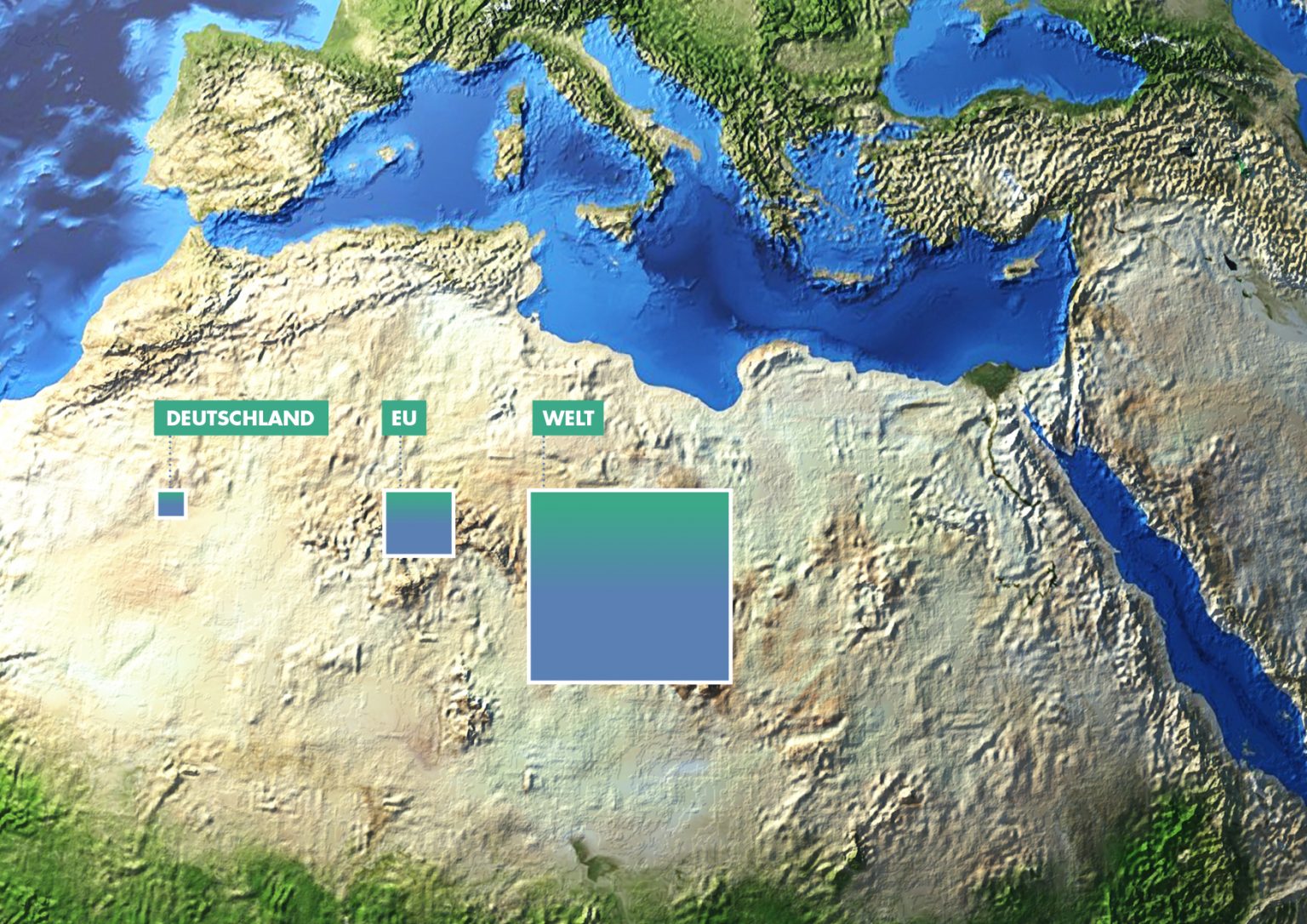
The chart from the German Aerospace Center (DLR) shows that there is no global shortage of renewable energy. Photovoltaics alone could meet the energy needs of the entire world using a very small area. This electricity from renewable sources then simply needs to be made transportable and storable. This is achieved by first converting electricity into hydrogen and then adding CO2 to produce an eFuel. This also explains the name of the synthetic fuel: electricity-based fuel. As hydrogen derivatives, eFuels are therefore essentially liquefied, and thus transportable, renewable electricity. Hydrogen itself could also be transported. However, this is very expensive, as hydrogen must be cooled substantially and kept under pressure. As the lightest element on Earth, hydrogen also diffuses quickly through transport pipes, creating another transport challenge.
Ultimately, the efficiency of eFuels production is therefore not that important. They simply need to be produced where renewable energy is not scarce. By comparison, producing eFuels using the conventional Fischer–Tropsch process in Germany would make about as much sense as an orange plantation in Germany. eFuels are produced in sunny and windy countries for the same reason.
The efficiency question can also be viewed from another angle: in terms of cost, time and resource efficiency, the most sensible approach is to reduce new CO2 emissions from existing vehicles and existing infrastructure. Unlike electric mobility, everything is already in place. More than 99 per cent of the approximately 1.4 billion cars worldwide have petrol or diesel engines. Reducing new CO2 emissions from the existing fleet therefore makes the greatest and fastest contribution to achieving global climate targets in the transport sector.
New CO₂ emissions and the greenhouse gas balance
Here, “new CO₂ emissions” means CO₂ emissions added to the atmosphere through the use of fossil fuels. Burning carbon-containing eFuels also releases CO₂. Any potential reduction must be assessed over the entire life cycle against a specifically identified fossil reference fuel. The electricity and CO₂ sources, production, transport and use are particularly important. A CO₂ cycle alone does not demonstrate climate neutrality.
By contrast, electric mobility requires entirely new infrastructure with high resource requirements and a correspondingly large CO2 footprint. Building very heavy electric cars also requires additional resources, further increasing their CO2 footprint (embedded CO2 emissions). Finally, Germany has a very high energy import requirement of 70 per cent, meaning that green molecules in the form of fuels have to be imported anyway. The liquid form is necessary because of its high energy density, which makes transport distance practically irrelevant (high transport efficiency). Once the liquefied electricity is in the country, it is more efficient to use it directly in systems independent of electricity, such as combustion engines and oil-fired heating, rather than first converting it back into electricity with losses and potentially storing it temporarily in batteries with further losses.
Myth #2: “eFuels will be expensive”
Scientific institutes such as the specialist reFuels group at KIT expect eFuels to be affordable within a few years. Manufacturers such as Saudi Aramco also state that 80 cents could be achievable within a few years, as electricity costs just one cent per kilowatt-hour in Saudi Arabia. Market-driven customer demand is essential for time- and cost-efficient adoption.
Myth #3: “eFuels should only be used in shipping and aviation.”
A restriction to the comparatively small and cost-sensitive sectors of shipping and aviation would hinder the ramp-up of eFuels. In addition, the production of aviation fuel automatically generates fuels for road transportation as by-products. So when thinking about the optimal use of resources, the synthetic by-products such as ePetrol, eDiesel and eHeating oil, which are created as by-products during the production of eKerosene, should also be used.
Summary:
- eFuels are produced in sunny and windy countries. These are mostly southern countries where photovoltaic systems or wind turbines can harvest renewable energy efficiently (the orange analogy). Most charts in the media are based on the incorrect assumption of eFuels production using the Fischer–Tropsch process in Germany.
- We do not have enough energy available in Germany. Germany’s energy import requirement is 70 per cent. This means we need to import molecules produced from renewable sources in the form of liquid energy carriers anyway. Their most efficient use is directly in systems independent of electricity, such as combustion engines and oil-fired heating.
- For vehicle propulsion, overall system efficiency from the gust of wind or ray of sunshine to the turning wheel is decisive. Electricity is either harvested at low efficiency in Germany, with the efficiency losses offset by the electric motor’s higher efficiency compared with a combustion engine, or renewable energy comes from countries where it can be harvested at high efficiency. Ultimately, the overall results are at the same level.
- Efficiency is not an end in itself; it is only relevant where there is scarcity or a cost advantage. There is no global shortage of energy from renewable sources.
- Completely rebuilding the technological world in addition to defossilising energy is not efficient in terms of costs, time, resources or climate.
- Allocating eFuels exclusively to ships and aircraft impedes the expansion of eFuels plants and ignores the co-products for road transport that arise during fuel production anyway.
Other regenerative, synthetic fuels
Incidentally, electricity-based eFuels belong to the group of regenerative, synthetic fuels. Other synthetic fuels that are also produced without petroleum are residue- and waste-based fuels such as Hydrogenated Vegetable Oils (HVO). These fuels are already produced very efficiently in Europe and North America. In line with the analogy with oranges and eFuels, these fuels are comparable to apples, which can be produced in Germany without much effort. Read more at klima-kraftstoffe.de
Newsletter registration
Notes on data protection
Our free newsletter informs you regularly by e-mail about new products and special promotions. The data you enter here will only be used to personalize the newsletter and will not be passed on to third parties. You can unsubscribe from the newsletter at any time or revoke your consent at any time by sending an e-mail to . Your data will be deleted within 2 months after you stop receiving the newsletter, provided that there are no statutory retention obligations to the contrary. By submitting the data you have entered, you consent to the data processing and confirm our privacy policy.

